
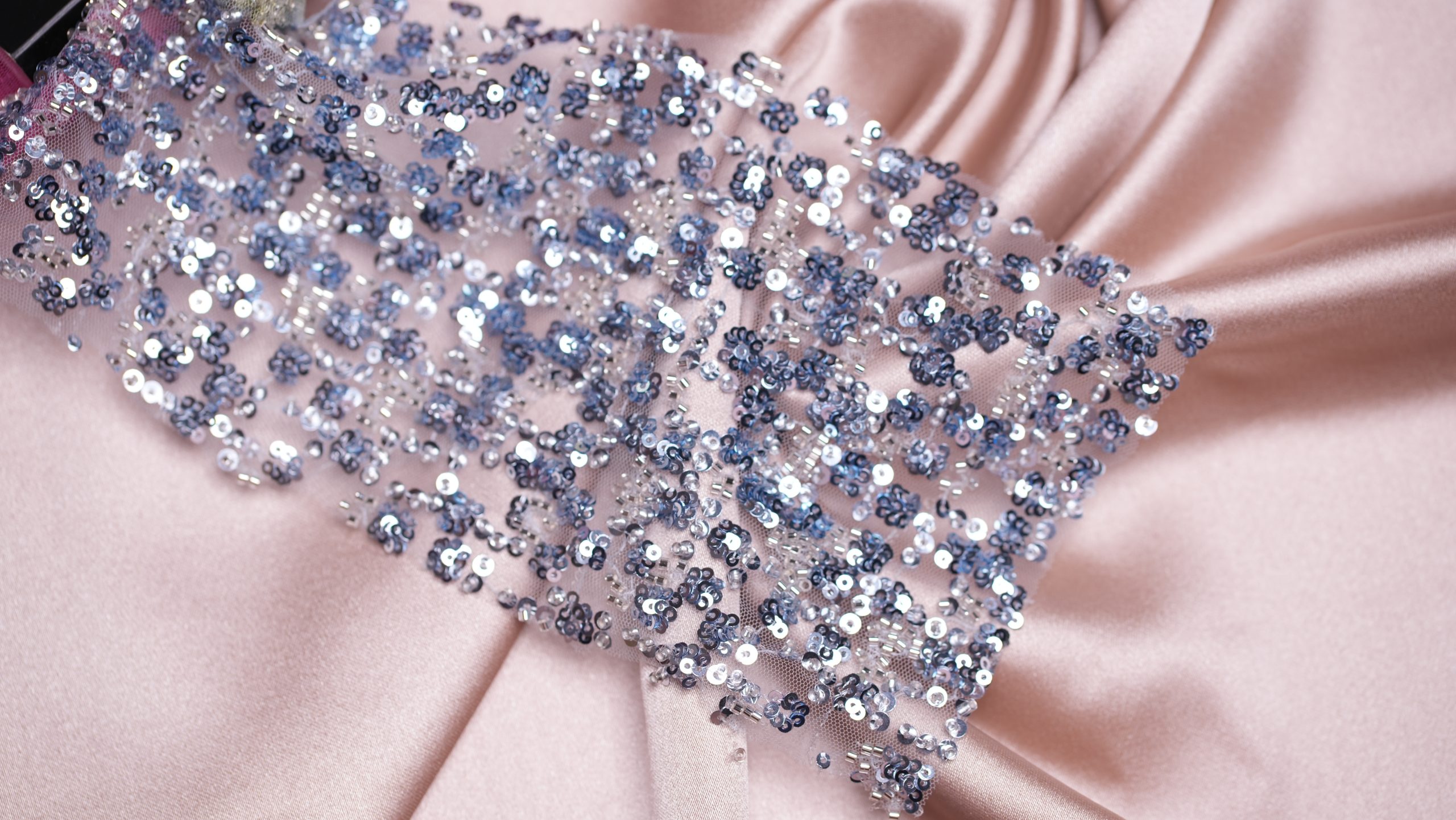
What is Hand-Beaded Embroidery?
Hand bead stitching is a traditional craft technique in which beads and sequins are hand-applied to fabric with a needle and thread, stitch by stitch, giving each piece a distinct personality that cannot be recreated identically. This form of needlework is distinguished by the artisan’s talent and precision, as well as the ability to create three-dimensional features and a rich texture that exudes luxury. As a result, it is frequently utilized in high-end and special pieces that demand meticulous attention to detail and a distinct identity.
What is Machine Embroidery?
Machine embroidery is a modern procedure that uses pre-programmed computerized machines to generate accurate and repeating designs on fabric swiftly and efficiently. This type allows for a high level of consistency in each piece, as well as the ability to execute complex patterns and fine details in less time and at a lower cost, making it an excellent choice for brands looking for a balance of professional quality and scalable production without sacrificing an elegant appearance.
Read also: What is Haute Couture? You simple guide
The primary distinction between hand-beading and machine embroidery
To distinguish between hand embroidery and machine stitching, they should be considered as two distinct philosophies: one honors the distinctive human touch, while the other emphasizes repeating geometric precision.
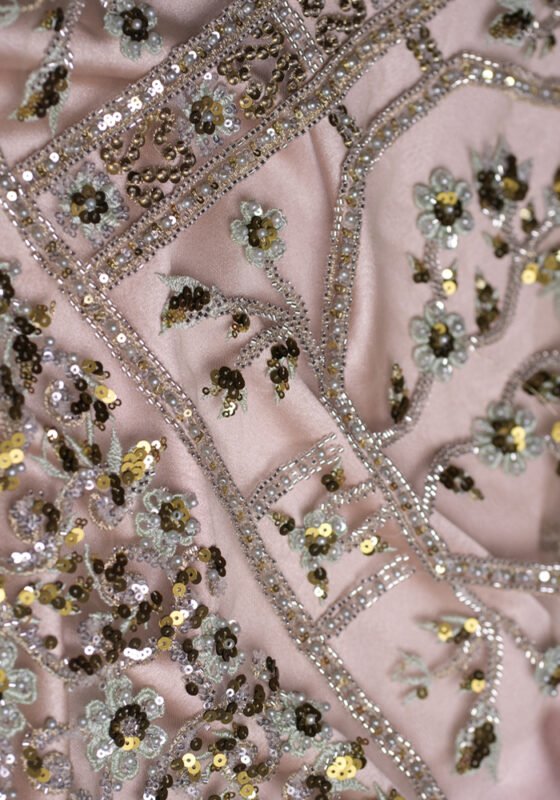
- Technology and the structure of the stitch (The stitch)
- Hand-Beading: It uses techniques like “Tambour” or the conventional needle. The stitches are not perfectly regular, giving the item a “spirit” and distinct (3D) qualities that are difficult to imitate. The threads are hand-knotted, allowing them to move with the fabric.
- Machine embroidery uses the lockstitch, which has two threads (upper and lower). The stitches are mathematically accurate and flatter than hand embroidery, making it suitable for complicated designs that require identical repetition.
- Materials
- Handmade: It has complete freedom in material selection; heavy jewels, feathers, delicate natural fibers, and enormous crystal pieces that could shatter the machine needle can all be used.
- Mechanical: Typically confined to threads, very small beads, or sequins that can be fed through the machine’s rollers. To endure the speed of mechanical needle movement, the materials must be thick and consistent.
Discover our most recent collection of Haute Couture
- Historical Context and Value of hand-beading
- Handmade: It is the foundation of Haute Couture and has long been connected with the upper classes. The value here is in the time; a dress that requires 500 hours of human labor has artistic and financial worth as a museum item.
- Mechanical: It first appeared during the Industrial Revolution to broaden the realm of beauty and make it more accessible. It was once considered a ‘lesser’ alternative, but in ‘Tech-Couture’, it is now employed as a revolutionary tool to create complicated sports and architectural designs that the human hand cannot achieve with the same speed or symmetry.
| point of comparison | Hand-Beading | Machine |
| Time | Weeks or Months | Hours or Minutes |
| Similarity | Unique (Each piece differs slightly) | Exactly Identical |
| Cost | Very high (technical labor) | Economic (intensive production) |
| Use | Luxury wedding dresses, the red carpet | Ready-made garments, logos, commercial textiles, and luxury wedding dresses |
| Strengths | The machine gives a luxurious look, but at a smarter price. Suitable for deadlines and collections. Harmony is critical to the success of current haute couture brands. |
Why has machine embroidery become the most appropriate choice in current couture?
Machine embroidery has evolved from an “economic alternative” to a “strategic partner” on worldwide display platforms. Here are the reasons why it’s the best pick in current couture:
- Achieving the Golden Balance: Luxurious Appearance and Execution Efficiency
The visual difference between fine hand embroidery and machine embroidery is no longer as pronounced as it once was; current machines can replicate the most intricate stitches with great precision. The smarter alternative here is to provide the same sophisticated design that the customer demands, but on a more realistic schedule, allowing firms to meet rising demand without sacrificing aesthetic standards.
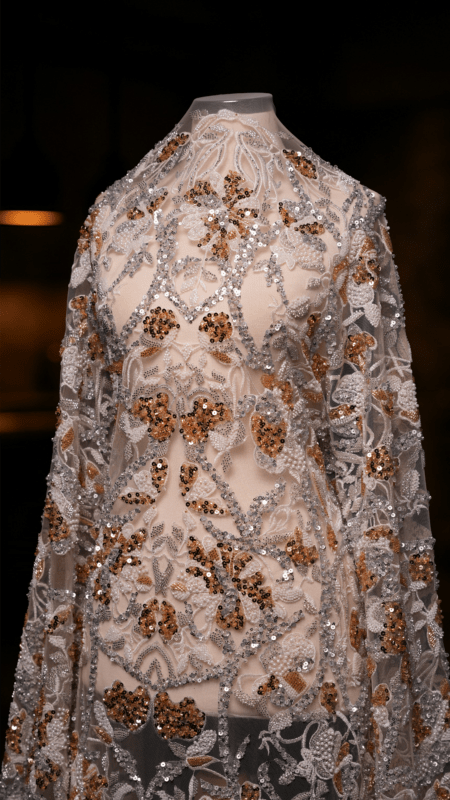
- Unlimited Creativity: More Experimentation Opportunities
In hand embroidery, a designer may be hesitant to change an idea because its implementation took weeks. However, automated processes make prototyping faster and easier. The designer may test thousands of patterns, colors, and complicated overlaps in a few days, allowing for the creation of ‘impossible’ ideas to implement if relying exclusively on the human hand.
- Scalability: From one unit to the ‘group’.
While traditional couture is limited to individual items, the machine enables budding and ambitious firms to create full collections of comparable quality. This change from “single piece” to “unified visual identity” allows the business to flourish and expand globally while ensuring that every piece in the collection fits the original model perfectly.
- Sustainability: Increased Accuracy and Reduced Waste
In an increasingly ethical world, technology plays an important role in decreasing waste.
- Fewer mistakes: The machine is designed to reduce the possibility of human error, which could harm meters of delicate silk.
- Precise usage: Thread and material quantities are estimated with digital accuracy, resulting in less consumption of environmental resources.
- Temporal sustainability: Shortening long working hours helps to create a more balanced and effective workplace.
When is machine embroidery the best option for you?
Choosing machine embroidery is a strategic option based on your professional objectives and the type of your present job. Here are the scenarios where machine embroidery is a winning bet.
- When ‘time’ tests your creativity (The Time Factor) If you are working on a collection for a specific season or have tight deadlines, the machine is your only rescue. While hand embroidery takes weeks, the machine can do the work in hours, allowing you to respond quickly to market demands.
- When “budget” is a factor (Budget Optimization) for designers or firms aiming to deliver luxury at competitive costs, machine embroidery has a cheaper production cost than costly manual labor. This allows you to allocate your funds to other areas, such as fabric quality or marketing, while still preserving the piece’s “elegant” appearance.
- Transition from ‘Unique Piece’ to ‘Production Line’ (Scalability)
If you intend to scale and produce more than one piece of the same design, the machine is your only option. It ensures that the 100th piece is the same as the first, which is very difficult in manual work affected by fatigue or changes in the artisan’s hand.
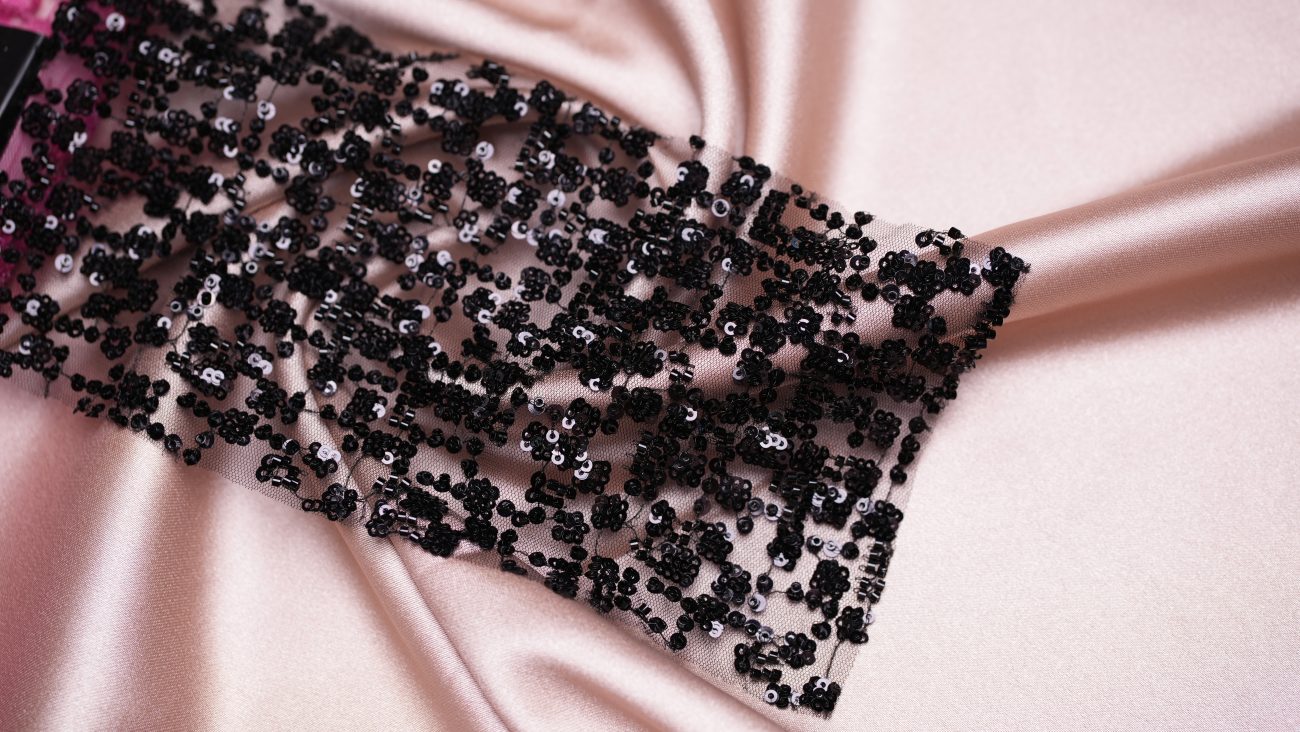
- The search for ‘absolute accuracy’ (consistency and professional finish)
The machine unquestionably wins in designs based on geometric shapes, emblems, or patterns that demand regular repetition. It delivers a ‘professional finish’ with crisp stitching and uniform dimensions, representing your brand’s organized, institutional image.
When do you choose the machine?
| If your aims are…. | Choose machine embroidery immediately because: |
| Speed | Reduces execution time by up to 90% |
| Repetition | Ensures the congruence of each piece in your collection. |
| Growth | It allows you to produce commercial quantities easily (Scalability). |
| Saving | Reduces labor costs and waste in raw materials. |
Does hand embroidery still have a place?
Certainly, hand needlework retains a sacred place that machines cannot replace, making it the ideal choice for ‘Ultra-luxury’ creations intended to be an artistic legacy passed down through time; it gives the object a personality and emotional depth that no programming can duplicate. However, it must be realized that this style of craftsmanship is not appropriate in all situations; although manual effort adds sumptuous value to an exquisite piece on the red carpet, it may stymie an ambitious commercial goal that requires expansion and wider reach. Finally, wisdom is in selecting the ‘tool’ that best suits the objective, as hand stitching is a ‘poetry’ of pure luxury, and machine embroidery is the ‘language’ of the current period for proliferation and professional differentiation.
Read also: Top Bridal Fabrics for Summer Weddings: Stay Cool and Elegant.
The modern trend is to combine both (a hybrid approach)
In 2026, major fashion houses are moving toward the “hybrid approach” as a brilliant solution that combines the best of both worlds: machines are used to create complex backgrounds and geometric patterns with exceptional precision and speed, and the handmade touch comes at the end to add large stones, feathers, or fine details that give the piece the “spirit” of couture. This combination is not just a fad, but is currently the most intelligent approach; it produces a piece that appears to have taken months of manual labor, when in fact it is the result of a harmonious collaboration between machine intelligence and human skill, achieving absolute luxury with modern efficiency.
Conclusion
The challenge in today’s fashion industry is no longer “Which one should we choose?” but rather “How do we intelligently integrate both?” Machine embroidery has proven to be not only a fast and efficient method, but also a key driver for ambitious brands seeking to balance luxury, precision, and scalability without compromising aesthetics. By clearly demonstrating the differences between machine and hand embroidery, it becomes evident that machine embroidery offers superior consistency, speed, and the ability to meet large-scale production demands while maintaining high-quality standards.
While hand embroidery remains a symbol of pure artistry and one-of-a-kind craftsmanship, the hybrid approach in 2026 emerges as the smarter solution. It enables designers to combine creativity with production efficiency, while still preserving the warmth and authenticity of the human touch. Luxury is now defined by intelligent execution, and choosing the right technology can transform a design from a simple garment into a sustainable, powerful brand capable of competing and expanding in an ever-evolving market.